
Multi-Sensory Experiential Art
Written by Yang Lim
If people were asked about where one can go to see visual art and what that experience would be like, conventional impressions that may come to mind would be dedicated art spaces where people can visit and look at the art—where the experience maintains a separation between the viewer and the artwork. In contrast, a number of artists in this year’s The Works Art and Design Festival take a more interactive approach and invite people to engage directly with the art, reshaping the public’s relationship to it. In doing so they prompt people to rethink their understanding and preconceptions of what art is, the forms that it can take and the ways in which meanings become ascribed to it.
One of this year’s artists, Kelly Andres, has participated in The Works festival previously. For this year’s edition, she offers ApotheCycle, which encourages people to engage in sensory experiences of various items through tactile and olfactory sensations. Mimicking the appearance of a traditional apothecary cabinet, her cart on wheels consists of a wooden multi-drawer box that contain numerous found objects with their own distinct smells, such as coffee beans, campfire embers, and many others. Generating curiosity is an important aspect of her work’s interactivity as people can open the drawers in any order that they wish to find out what lies within. This adds to a sense of discovery, delight, and surprise and frames the artistic experience as something to which people can contribute and shape its meanings. As Andres mentions in her Artist Interview for this year’s festival, smells can provide a powerful trigger for the creation of stories and the evocation of memories. People’s interactions with these objects will provide opportunities for contemplation and dialogue with others through shared knowledge, understandings, and experiences.
Like Andres’ work, Isabelle Kirouac and Willoughby Arévalo’s The Aromatic Wheel of Fungi also encourages people to experience their work through senses other than sight. The first thing that will catch people’s attention is the large, white wheel that has been drawn on a black surface, which Kirouac and Arévalo have populated with numerous tidbits about different types of smells. Developed collaboratively with input from people and mushroom guides, the wheel is a continually evolving catalogue of information. Besides increasing people’s appreciation for the diversity of aromas that exist, it will encourage their inquisitiveness around how smells can evoke personal recollections and facilitate the creation of shared meanings. During specific days of the festival, the wheel’s centre has a circular table with see-through globe-shaped containers, each of which contain different types of mushrooms that have their own distinct odours, appearances, and textures. People are invited to pick up these containers, take a closer look, and even smell the mushrooms. If done in groups, this shared experience becomes an opportunity for interaction with others. As such, this work demonstrates how art can be experienced as both an individual and a collective activity and how it can offer moments for positive interpersonal connection.
Kerry Ross’s Alive! A Garden Party also takes nature as its starting point in order to prompt conversations about the ways in which urban spaces can be better designed for the public’s benefit and well-being. Characterized by a profusion of greenery, this interactive installation includes a squarish, wooden building that is surrounded by flowers and other plant life. Greenery has been installed on the building’s rooftop, on the backside of the building, in small containers that rest on the ground, as well as in large square containers at the front. People are invited to wander around the installation to check out the plants. They can also enter the building itself to view photography by Bram van Herwaarden as well as print media artist Carrie Phillip Kieser’s contributed designs that decorate the building’s doors. Taken as a whole, it evokes the impression of an urban garden that people can walk through and, for a moment, forget that they are in a public space.
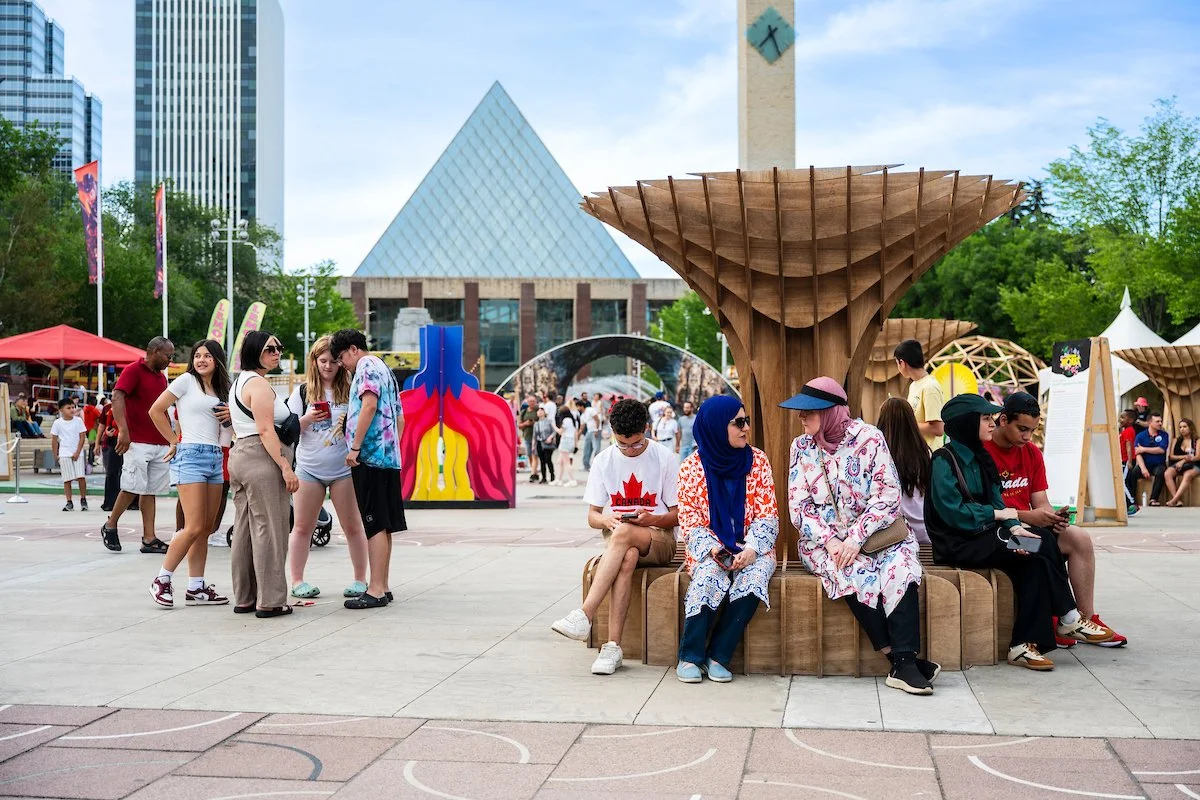
Jonathan Monfries’ Canopy and Jill Stanton’s Supergarden round out this year’s grouping of interactive artworks on Churchill Square. Given the size of both installations, people cannot avoid passing by them when they wander through Churchill Square. Both works have appeared previously in this festival and, in their own ways, blend into the urban landscape of Edmonton’s downtown and subtly encourage people to interact with them. Constructed from wooden materials, Canopy consists of five structures with seating that are also evocative of real trees, demonstrating how something can be both functional as well as aesthetically pleasing as art. Like Ross’s Alive! A Garden Party, Monfries’ work raises questions about the usage and design of urban public spaces. With its functional purpose as seating, the installation opens up possibilities for people to reflect and engage, perhaps with other people passing by or who have taken a seat as well. Stanton’s work also shares similarities with Ross’s installation by inviting people to pause, wander around each piece, and contemplate their relationship with nature. Consisting of large, vividly coloured flower-like structures, they offer a sharp contrast to the grey concrete and other drab colours associated with the built environment. As an exemplar of her site-specific works that strive to generate new narratives and meanings, Supergarden visually instigates a role reversal that will catch people’s attention. Instead of being larger, in control of, and dominant over nature, people are now dwarfed by it within this installation’s physical space, which can spur possibilities for questioning long-held assumptions about the relationship between human society and nature.
Taken together, these artists all push the boundaries of art by inspiring the public to use more than their sense of sight. Besides enlivening people’s experience of art and framing it as a participatory endeavour that dissolves the boundary between “art” and “viewer,” these multi-sensory works challenge people’s assumptions and perceptions about a variety of topics—nature, urban spaces, society’s relationships with the natural environment, how people construct meaning and relate to others, and more. In doing so, they reshape people’s understandings about what art can look like, what it can do, and how it can be a meaningful part of people’s daily experiences, both in a practical sense and in terms of the intangible benefits that it can bring to them.